The Story of a Mother
by Hans Christian Andersen
A mother sat beside her little one’s cradle, deeply distressed and anxious, for she feared the little one might die. Indeed, he was pale as wax, his little eyes half closed, and he breathed almost imperceptibly, now and then with a deep sigh. The mother’s sorrow grew with each moment as she watched the tender creature.
There was a knock at the door, and an old poor man entered, wrapped in a loose cloak that looked like a horse blanket—blankets that are meant to warm, but he was freezing. It was the dead of winter; outside, everything was covered in ice and snow, and a biting wind blew.
Since the old man was shivering with cold and the child had fallen asleep, the mother rose and placed some beer to heat in a pot on the stove to warm the old man. He sat down beside the cradle and gently rocked the child. The mother returned to her place and kept gazing at her little one, who breathed laboriously and raised his tiny hand.
Mother: “Do you think he will live? Surely the good Lord won’t take him from me!”
The old man, who was Death himself, made a strange gesture with his head; it could have been either yes or no. The woman lowered her eyes, and tears rolled down her cheeks. Her head was heavy; she had not slept for three nights, and she fell into a brief doze; but she awoke instantly, shivering with cold.
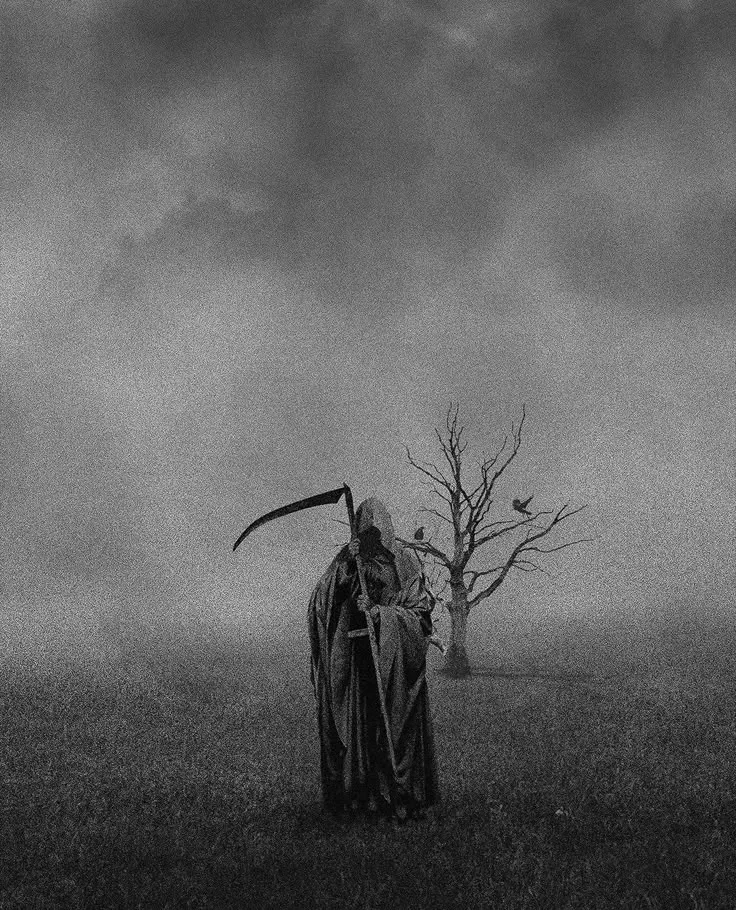
Mother: “What is this?”
She looked around. The old man had vanished, and the cradle was empty. He had taken the child! The clock in the corner gave a dull sound, the heavy lead weight dropped with a screech to the floor—bang!—and the hands stopped.
The desperate mother rushed out into the street, seeking her child. In the snow stood a woman clad in a long black robe, who said:
Woman in Black: “Death has been in your house; I saw him hurry away with your little one. He flies swifter than the wind and never returns what he has taken!”
Mother: “Tell me which way he went! Show me the path, and I shall find him!”
Woman in Black: “I know the path, but first you must sing me all the songs with which you lulled your child to sleep. I love them; I have heard them many times, for I am Night. I watched your tears fall as you sang.”
Mother: “I will sing them all, all! But do not delay me, so that I may overtake him and find my child!”
Night stood silent and still, and the mother wrung her hands and sang and wept; there were many songs, and still more tears. Then Night said:
Night: “Go to the right, into the dark fir forest. I saw Death go there with your child.”
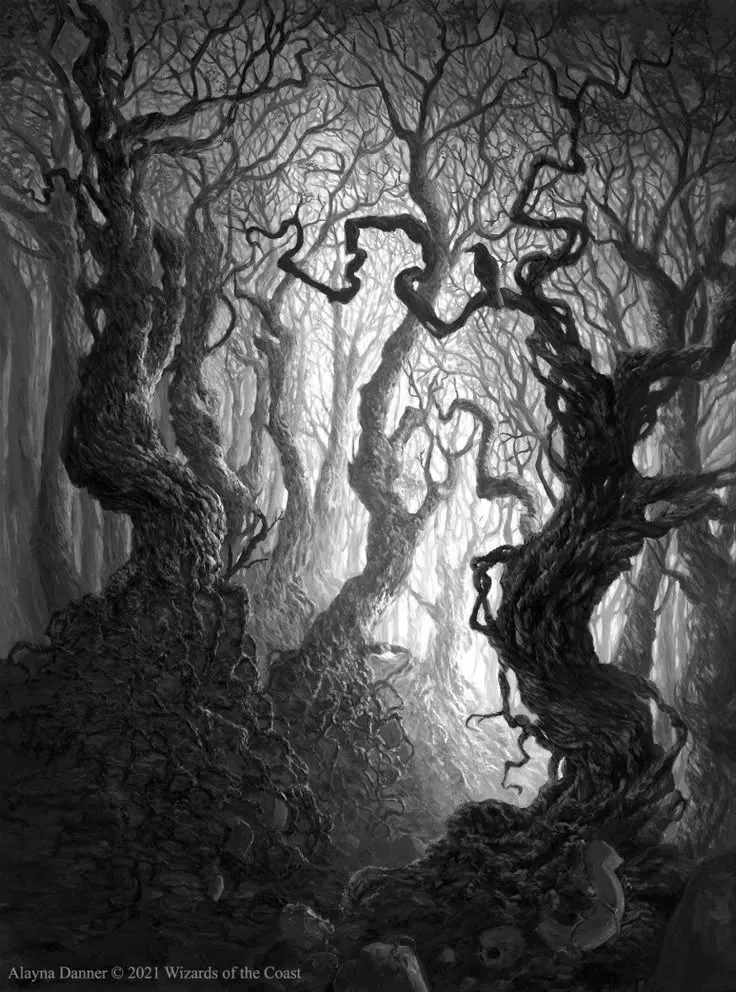
Deep in the forest, the path divided, and the woman did not know which way to take. There stood a thornbush, leafless and flowerless, for it was winter, and its branches were thick with ice and snow.
Mother: “Have you seen Death pass by with my child?”
Thornbush: “Yes, but I will not tell you which way he went unless you warm me in your breast; I am freezing, and my branches are icy.”
She pressed the thornbush to her breast to warm it, and the thorns pierced her flesh, and blood flowed in large drops. Yet fresh leaves and blossoms sprang from the bush in that winter night, such was the warmth of the grieving mother’s heart. And the bush told her which path to take.
She came to a great lake, where no boat was to be seen. It was not frozen solid enough to bear her weight, nor was it shallow enough to wade through; yet she had to cross it if she wanted to find her child. She threw herself on the ground, resolved to drink it dry, but what mortal could do that? Still, the anguished mother hoped for a miracle.
Lake: “No, you will never succeed. But let us make a bargain. I love to collect pearls, and your eyes are the two purest pearls I have ever seen. If you weep them out for me, I will carry you to the great greenhouse where Death tends flowers and trees; each of them is a human life.”
Mother: “Oh, what wouldn’t I give to reach my child!”
She wept more bitterly still, until her eyes fell from her face into the depths of the lake, where they became the most precious pearls. The lake lifted her like a swing and flung her to the opposite shore in a single wave.
There stood a great building, its façade over a mile long. It was impossible to tell whether it was a mountain with forests and caves or masonry; and less could the poor mother, now blind from weeping, discern it.
Mother: “Where shall I find Death, who took away my child?”
Old Woman: “He has not come back yet. How did you find your way here?”
Mother: “God helped me. He is merciful, and you will be too. Where can I find my child?”
Old Woman: “I do not know, and I see that you are blind. Tonight many flowers and trees have withered; Death will soon come to transplant them. You surely know that every person has their own tree of life or flower, depending on their nature. They look like ordinary plants, but a heart beats within each; even a child’s heart can beat. Listen, perhaps you will recognize your child’s heartbeat. But what will you give me if I tell you what else you must do?”
Mother: “I have nothing left to give, but I will go to the ends of the earth for you.”
Old Woman: “There is nothing there that I want. But you can give me your long black hair; you know it is beautiful, and I like it. I will give you mine in exchange—it is white, but it will serve you.”
Mother: “Is that all? Take it, take it gladly.”
She gave her beautiful hair and took in exchange the old woman’s white hair.
Then they entered Death’s great greenhouse, where trees and flowers grew in wondrous mixture. There were splendid hyacinths under glass bells, and great peonies as sturdy as trees; there were also water plants, some lush, others sickly, around which water snakes twined, and black crabs clung to their stems. Magnificent palms grew, and oaks and plane trees; parsley and thyme were there too. Every tree and flower had its name; each was a human life, and the person lived somewhere—one in China, one in Greenland, or elsewhere in the world. There were large trees planted in pots so small they seemed about to burst, while tiny flowers grew in rich soil covered with moss.
The grieving mother bent over the smallest plants, hearing the human heart beating within each; and among millions she recognized her child’s heartbeat.
Mother: “It is this one!”
She reached toward a little blue crocus that drooped on its stem, gravely ill.
Old Woman: “Do not touch the flower. Stay here, and when Death comes, do not let him uproot it. Threaten to do the same with others, and he will fear you. He is answerable for them to God; none may be uprooted without His permission.”
Suddenly an icy chill filled the place, and the blind mother knew that Death had entered.
Death: “How did you find your way here before me?”
Mother: “I am a mother!”
Death stretched out his hand toward the crocus, but she held her own hands firmly over it, though she trembled lest she harm one of its leaves. Death blew upon her hands, and his breath was colder than the polar wind. Her hands dropped lifelessly.
Death: “You can do nothing against me.”
Mother: “But God can!”
Death: “I do only His will. I am His gardener. I take all His trees and flowers and transplant them into the garden of Paradise, into the unknown land; and you do not know what happens there, nor may I tell you.”
Mother: “Give me back my child!”
Suddenly she seized two beautiful flowers and cried:
Mother: “I will tear them all up, for I am in despair!”
Death: “Do not touch them. You say you are unhappy, yet you would make another mother as miserable as yourself.”
Mother: “Another mother!”
She released the flowers. “Who is that mother?”
Death: “There are your eyes. I took them from the lake; they shone so brightly! I did not know they were yours. Take them back; they are clearer than before. Now look into the deep well at your side; I will tell you the names of the two flowers you would have torn up, and you shall see all their future, their entire lives. See what you nearly destroyed.”
She looked into the well. One of the flowers was a blessing to the world, spreading joy; the other brought sorrow, misery, pain, and want.
Death: “Both are as God has willed.”
Mother: “Which is the flower of misfortune and which the one of happiness?”
Death: “I will not tell you. You only know that one of them was your child. You have seen the destiny God had prepared for your child, his future on earth.”
The mother cried out in anguish: “Which of the two was my child? Tell me! Free me from this doubt! But if it is the unhappy one, take him away, spare him the misery; carry him to God’s kingdom! Forget my tears, forget my prayers, forget all I have said and done!”
The mother wrung her hands, fell to her knees, and prayed to God:
Mother: “Do not listen to me when I ask for something against Your will, which is the wisest! Do not listen to me! Do not listen!”
She bowed her head on her breast, while Death departed with the child into the unknown world.